


Case Study: Betty and Barney Hill, New Hampshire

On a September night in 1961, a New Hampshire couple driving home through the White Mountains reported a close encounter with an unidentified craft, told the Air Force the next day, and became the first widely known Americans to describe being taken aboard.
Betty and Barney Hill were not people who went looking for attention. Barney was a postal worker and the legal redress officer of the Portsmouth branch of the NAACP. Betty was a social worker for the State of New Hampshire. They were an interracial couple in early-1960s New England, active in civil rights work, and they had every reason to avoid being talked about.
What they reported happened on Route 3, south of Lancaster, in the early hours of September 20, 1961. Their account has two parts, and they rest on very different evidence. The first part, a close sighting of a lighted craft with figures visible in its windows, they remembered consciously and reported within days, to the Air Force and to a civilian investigator. The second part, the account of being taken aboard and examined, emerged more than two years later under hypnosis with a Boston psychiatrist who never accepted it as literal.
This NPI Preliminary Review sets out both parts, what the record shows, the strongest skeptical explanations, and why the Hills still matter to anyone trying to understand people who report experiences like theirs.
Sources: Walter N. Webb, “Dramatic UFO Encounter in the White Mountains, New Hampshire” (NICAP, Aug. 30, 1965) · Portsmouth Historical Society, “Betty & Barney” (2026) · University of New Hampshire, Betty and Barney Hill Papers (MC 197)

We both have been quite frightened by this experience but fascinated.
The Drive Home
The part of the story the Hills remembered without hypnosis is the part they reported first, and it is strange enough on its own.
The Hills were returning to Portsmouth from a short trip to Niagara Falls and Montreal. They left a restaurant in Colebrook at about 10 p.m. on September 19 and drove south on Route 3 through the mountains. Somewhere near Lancaster they noticed a bright light in the sky that seemed to be following the car.
They stopped several times to look. Near Indian Head, south of Franconia Notch, the light came close. Barney got out with a pair of binoculars and walked into a field toward it. In the account he gave investigators in 1961, the object hovered perhaps 80 to 100 feet up and a few hundred feet away, and through the binoculars he could see “eight to eleven separate figures watching him at the windows,” of human form and dressed in shiny dark uniforms.

Indian Head, the rock profile above US Route 3 in Lincoln, New Hampshire, near where the Hills reported their closest encounter. (Photo: muffinman71xx, CC BY-SA 2.0)
Barney ran back to the car in a panic. Betty remembered him repeating, “they’re going to capture us.” They drove off, heard a series of beeping or buzzing sounds from behind the car, felt drowsy, and heard a second set of beeps miles down the road. They reached home at dawn, later than the drive should have taken. By their reckoning, about two hours could not be accounted for.
Sources: Webb (1965), quoting his Oct. 21, 1961 interview · Richard Hall, The UFO Evidence, Vol. II · NH Division of Historical Resources, marker no. 224
What They Reported, and When
The Hills put their account on the record almost immediately, long before there was any book, film or hypnosis.
On September 21, the day after they got home, Betty telephoned Pease Air Force Base in Portsmouth. Maj. Paul W. Henderson of the base’s bomb wing called back and took a report, and an Air Intelligence Information Report dated that day went to the Air Force’s Project Blue Book. The state’s historical marker on Route 3 notes that they “filed an official Air Force Project Blue Book report of a brightly-lit cigar-shaped craft the next day.”
The Blue Book record card for the case, now public, summarizes what they described: a “continuous band of light,” “cigar shaped at all times despite changes of direction,” with wings that “seemed to appear” from the main body and red lights on the tips. Its evaluation attributes the sighting to a strong temperature inversion and says the light “has all characteristics of an advertising search light.”
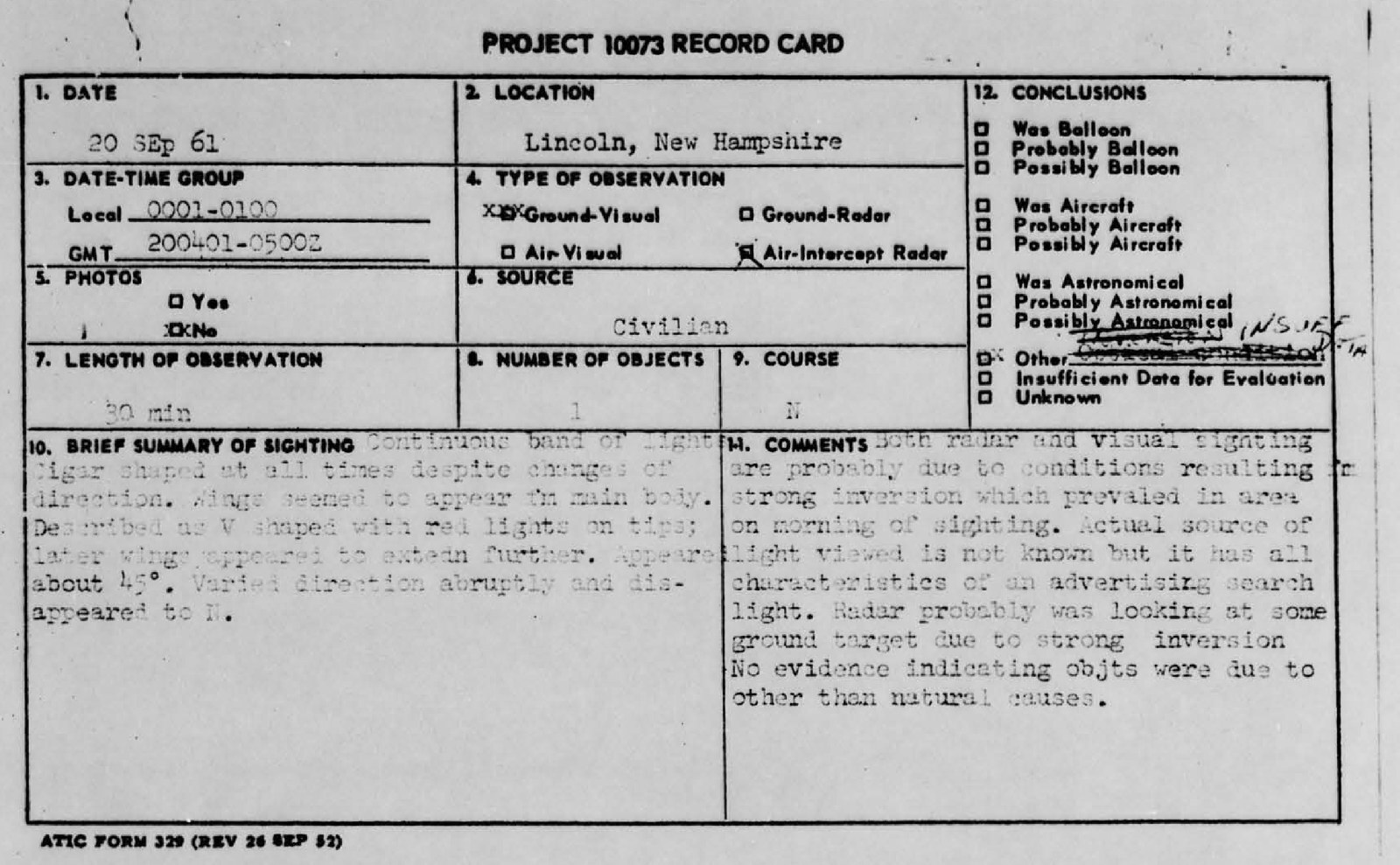
The Project Blue Book record card for the Hills’ sighting, dated September 20, 1961, “Lincoln, New Hampshire.” (US Air Force, National Archives, public domain)
On September 26, Betty wrote to Donald Keyhoe at NICAP, the leading civilian UFO research group of the day. NICAP sent Walter N. Webb, a lecturer at Boston’s Hayden Planetarium, who interviewed the couple for six hours on October 21. Webb later wrote that he was “impressed by their intelligence, apparent honesty, and obvious desire to get at the facts,” and that he believed the first encounter happened as they described it.
The Air Force’s explanations did not stay consistent. In September 1963, answering a citizen’s inquiry, its Foreign Technology Division wrote that the case was “carried as insufficient data,” that “without positional data the case could not be evaluated as Jupiter,” and then, a few lines later, that “the object was in all probability Jupiter.” An advertising searchlight in 1961; insufficient data, and Jupiter, in 1963.
Sources: Project Blue Book file 1961-09 “Lincoln, New Hampshire” (record card; Foreign Technology Division letter, Sept. 27, 1963) · Webb (1965), including the Keyhoe letter · UNH, Betty and Barney Hill Papers, Box 5 · NH historical marker no. 224 (2011)
The Hypnosis Sessions
The abduction account came later, under hypnosis, and the psychiatrist who drew it out came to a careful conclusion of his own.
In the weeks after the sighting, Betty had a series of vivid dreams of being taken aboard a craft. Barney developed persistent anxiety. In late 1963 they were referred to Dr. Benjamin Simon, a Boston psychiatrist and neurologist experienced in hypnosis, and over about seven months in 1964 he hypnotized each of them separately.
Under hypnosis, both described being stopped on the road, led aboard by small beings with large eyes, and examined, then returned to the car with the memory blocked. Betty said she was shown a star map. Their accounts agreed on many points and differed on others.
Dr. Simon’s conclusion is part of the record and belongs on this page. He never doubted that the Hills had seen something in the sky. He did not believe the abduction happened as a physical event. In his view it was most likely a reproduction of Betty’s dreams, which Barney had absorbed by hearing her retell them. He was equally clear, in letters written years later, that his view did not question the Hills’ honesty.
The story became public in October 1965, when the Boston Traveler ran a front-page series without the couple’s consent. The writer John G. Fuller followed with a book, The Interrupted Journey (1966), written with the Hills’ cooperation and drawing on the session tapes. In 1975 NBC broadcast a television film, The UFO Incident, with James Earl Jones and Estelle Parsons as Barney and Betty.
Sources: Webb (1965) · Dr. Benjamin Simon’s letters to Philip Klass (Oct. 28, 1975) and Robert Sheaffer (Aug. 24, 1976) · John G. Fuller, The Interrupted Journey (Dial, 1966) · UNH, Hill Papers (hypnosis session transcripts 1 to 9)
Skepticism and Alternative Explanations
The skeptics have real points here, and some of them should simply be conceded.
The star map. In the late 1960s an Ohio schoolteacher, Marjorie Fish, built three-dimensional models of nearby stars and argued that Betty’s sketch matched a view centered on Zeta Reticuli. The match drew wide attention in the 1970s. Later star-position data from the Hipparcos satellite placed several of her stars far from where her model needed them, and Fish herself later said she no longer thought the correlation likely. This page does not rely on the map.
Television. The researcher Martin Kottmeyer pointed out that an episode of The Outer Limits featuring a large-eyed alien aired on February 10, 1964, twelve days before a session in which Barney described and drew beings with eyes that wrapped around the sides of the head. Critics argue that dreams, television and the hypnosis itself shaped the abduction account.
Planets, searchlights and a beacon. The Air Force suggested an advertising searchlight and later Jupiter. Skeptics have also proposed a lighted beacon on Cannon Mountain, along their route.
The radar return. A Pease radar log records an unidentified aircraft on approach at 2:14 a.m. that night, and the Blue Book card files radar alongside the visual sighting. It is sometimes cited as confirmation. But the return was far from the Hills’ route and came after their sighting, and NICAP’s own reviewers judged it probably unrelated. This page does not rely on it.
Betty’s later years. After Barney’s death, Betty reported frequent sightings near her home that other observers identified as ordinary aircraft and lights. Critics have used this to question her original account.
What is still open. None of these explanations reaches the core of the case. The Hills reported a close sighting, with figures at the windows, within a day, to the Air Force, before any hypnosis, publicity or television episode. A trained investigator who spent six hours with them found them credible. Jupiter does not descend to a few hundred feet over a field, and a beacon does not have windows. Even the psychiatrist who doubted the abduction never doubted the sighting.
Sources: Terence Dickinson, Astronomy (Dec. 1974) · Armagh Observatory and Planetarium, “Betty Hill’s UFO Star Map: The Truth” · Martin Kottmeyer, Magonia (Jan. 1990) · Robert Sheaffer · NICAP, Pease AFB radar report and Richard Hall’s 1979 assessment
Why the Hills Matter to Experiencers
The Hill case created the template that thousands of later accounts would follow: a drive at night, a light, missing time, troubling dreams, and memories recovered under hypnosis. Researchers still argue about how much that template shaped what came after. What is not in dispute is the price the Hills paid for telling it. They were ridiculed, they lost control of their own story when a newspaper published it, and they spent years answering for it.
They handled it with a seriousness that is easy to forget. They went to the Air Force and to a scientific investigator first, not to the press. They sought medical help, not publicity. Barney, who died in 1969 at 46, kept up his civil rights work throughout. Betty, who died in 2004, kept the record: her notebooks, correspondence and the session transcripts went to the University of New Hampshire after her death, where anyone can study them.
People who report experiences like the Hills’ still face the same choice: stay silent, or speak and be laughed at. Disclosure that is full and responsible has to include them. That means taking their reports seriously enough to record and investigate them, and being honest about what the evidence does and does not show.
In 2026 the Portsmouth Historical Society opened an exhibition, “Betty & Barney,” that tells their story as both a UFO case and a chapter in New Hampshire’s civil rights history.
Sources: Portsmouth Historical Society · New Hampshire Public Radio (Apr. 13, 2026) · UNH Milne Special Collections
Further Reading
- Walter N. Webb, “Dramatic UFO Encounter in the White Mountains, New Hampshire” (NICAP, 1965)
- John G. Fuller, The Interrupted Journey (1966)
- Betty and Barney Hill Papers, MC 197, Milne Special Collections, University of New Hampshire
- Kathleen Marden and Stanton T. Friedman, Captured! The Betty and Barney Hill UFO Experience (2007)
- New Hampshire historical marker no. 224, “Betty and Barney Hill Incident,” US Route 3, Lincoln
Citizens for Disclosure
The Hills went to the Air Force first, and their report sat in a file for years. Citizens for Disclosure is NPI’s national volunteer network, working for a public record that treats witnesses and experiencers with respect: free to join, no donation required, and our team will help you find your place in it.
Related
- Case Study: Father Gill and the Boianai Sightings, 1959 · Core Learning Tool
- Case Study: The Ariel School Encounter, 1994 · Core Learning Tool
- Case Study: The Rendlesham Forest Incident, 1980 · Core Learning Tool
- Case Study: The Malmstrom Missile Shutdowns, 1967 · Core Learning Tool

