


Case Study: Father Gill and the Boianai Sightings, Papua New Guinea

On two evenings in June 1959, an Anglican priest and dozens of people at his mission in Papua watched a glowing craft with figures on its deck, and when the priest waved, he and his witnesses reported that the figures waved back.
Boianai is a small Anglican mission on Goodenough Bay, on the northeast coast of Papua, in what was then an Australian-administered territory and is now Papua New Guinea. In 1959 the priest in charge was the Rev. William Booth Gill, a 31-year-old Australian from Melbourne who had spent much of the past decade in the territory’s mission schools.
Gill was by his own account a doubter about flying saucers. What makes his case stand out is not only what he reported but how: he wrote notes as events unfolded, timed to the minute; he gathered the people who watched with him that same evening; and more than two dozen of the 38 witnesses on the first night signed a written statement. Most of them were Papuan teachers, medical assistants and mission staff. A copy of the whole record, with the witnesses’ names blacked out, sits in the US Air Force’s Project Blue Book files.
Among close encounters that involve reports of beings, this one is unusual. There was no hypnosis, no missing time, no money and no later embellishment. There is a community of witnesses, a written record made on the spot, and a priest who for the rest of his life described what he saw calmly and without claiming to know what it was.
Sources: Project Blue Book file 1959-06 “New Guinea” (US Air Attaché, Australia, report 1,403,022, Jan. 1960) · Rev. Norman E. G. Cruttwell, “Flying Saucers Over Papua” (1960) · Bill Chalker, “UFOs Sub Rosa Down Under” (1996) and obituary of Gill (2007)

I stretched my arm above my head and waved. To our surprise the figure did the same.
The First Night: June 26
The priest kept a running log, and more than two dozen people signed their names to what they saw before the night was out.
The mission had been hearing about strange lights for weeks. Gill had seen a stationary white light himself in April, and on June 21 one of his teachers, Stephen Gill Moi, reported a sighting of his own.
At 6:45 p.m. on June 26, Gill saw a bright white light to the northwest. It came closer. In his notes, it was a large disc with what appeared to be a deck on top, and on that deck figures moved about. “There are four men in all,” Gill wrote, “occasionally two, then one, then three, then four.” He also recorded “a shaft of blue light, which emanated from what appeared to be the centre of the deck.”
The main object and several smaller lights came and went for about four hours. Gill kept a data sheet, logging times and movements, until the sky clouded over and heavy rain began at 11:04 p.m. Thirty-eight people watched at some point that evening, and the way their testimony was gathered is part of what makes the case strong. According to the report preserved in the Air Force file, the witnesses were brought together in a lighted room as soon as the object vanished into cloud. Three observers, working in separate parts of the room, each drew what they had seen; the sketches were compared and found to differ only in size. Everyone was then told they must be truthful and should sign only if they believed they had seen the object as drawn. That report puts the count at 27 of the 38; other transcriptions give 25. Among the signers were Gill and the teachers Stephen Gill Moi and Ananias Rarata.
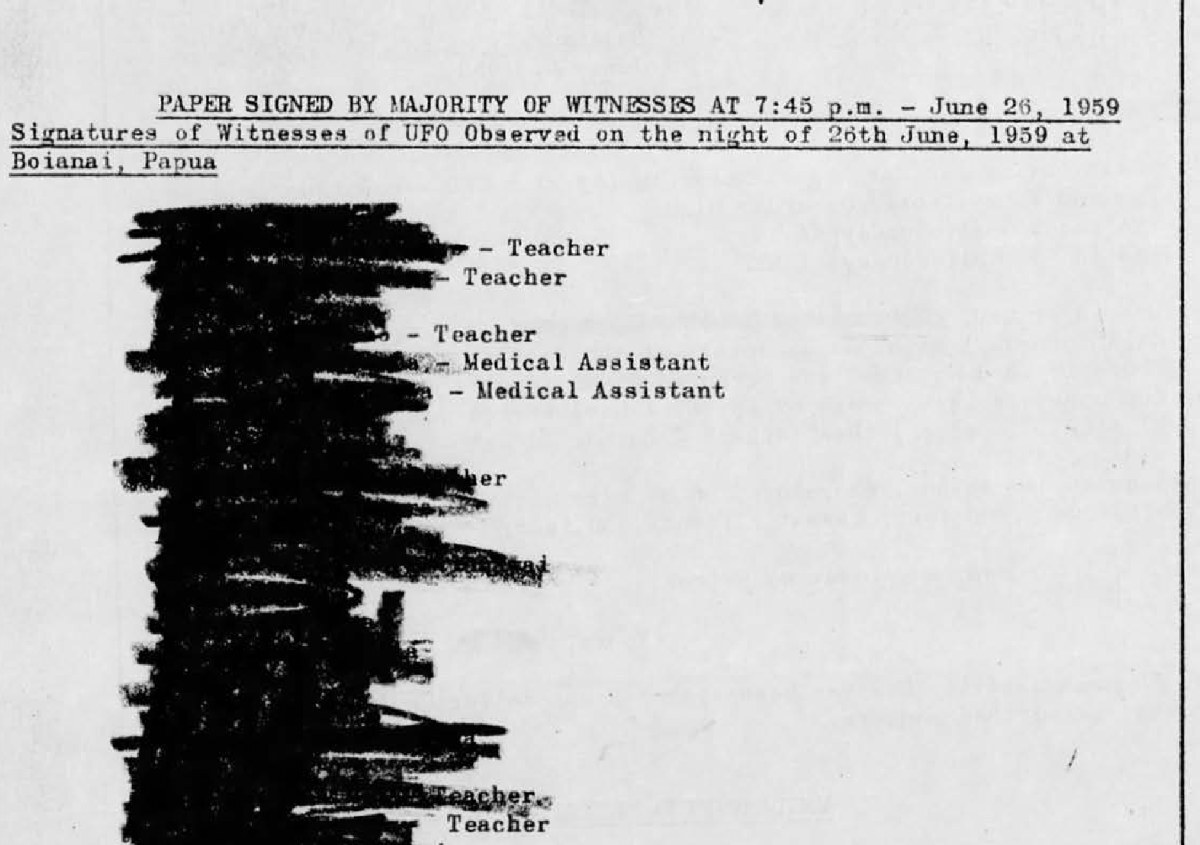
The signature page from the Boianai report as it survives in the US Air Force’s Project Blue Book file, headed “Paper signed by majority of witnesses at 7:45 p.m. – June 26, 1959.” The names were blacked out before release; the titles that remain are teachers and medical assistants.
Sources: Gill’s data sheet, “6.45 to 11.04 p.m. 26.6.59,” and the signed statement, in Project Blue Book file 1959-06 “New Guinea” and as transcribed in Cruttwell (1960) · Chalker (1996)
The Second Night: June 27
The episode that made the case famous lasted a few minutes, and the people who saw it reported it in the same plain way the next morning.
At about 6 p.m. the next evening, a mission worker spotted the object again, and Gill came out to look. Figures were again visible on top. In Gill’s written statement: “I stretched my arm above my head and waved. To our surprise the figure did the same.” His teacher Ananias Rarata “waved both arms over his head, then the two outside figures did the same.” Gill wrote that he and Ananias began waving together and “all four now seemed to wave back.”
Gill sent for a flashlight and signaled toward the object with a series of long dashes. In his account, the object answered with wavering motions back and forth. “There seemed to be no doubt that our movements were answered,” he wrote. The mission’s boys made audible gasps.
Then Gill did something that has puzzled readers ever since: at 6:30 p.m. he went in to dinner. At 7 p.m. the object was still there, and the community went to church for Evensong. By the time the service was over, the sky had clouded. Gill explained later that nothing about the sight had seemed threatening. He took the object for an advanced aircraft of human design: “I took it to be some kind of hovercraft the Americans or even the Australians had built.” It was, he said, “all so ordinary, as ordinary as a Ford car.”
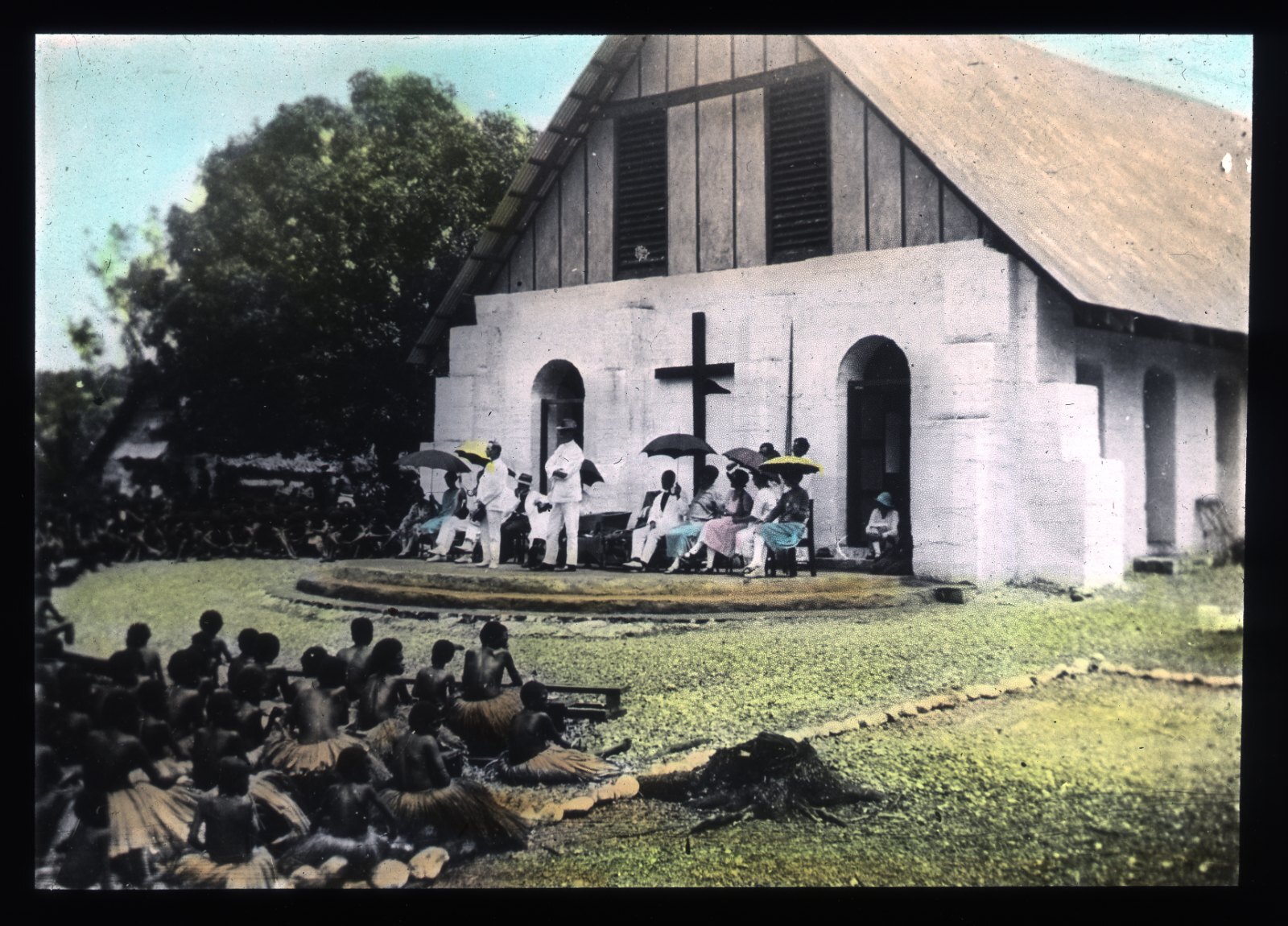
All Saints Church at the Boianai mission, in an early twentieth-century hand-colored lantern slide. (University of Newcastle Special Collections, public domain)
Sources: Gill’s statement of June 27, 1959, in Project Blue Book file 1959-06 “New Guinea” and as transcribed in Cruttwell (1960) and Chalker (1996) · Gill interviews quoted in Rowan Callick, Papua New Guinea Post-Courier (2009), and in Chalker’s case file
How the Authorities Responded
The report reached the Royal Australian Air Force, Australia’s Parliament and the US Air Force.
Gill’s notes reached the Rev. Norman Cruttwell, a fellow Anglican priest at a nearby mission, who was collecting reports from across the region. His 1960 report, “Flying Saucers Over Papua,” compiled dozens of sightings and reproduced Gill’s notes and the signed statement. The wave of Papuan reports also drew a question in the Australian Parliament in November 1959, when the Minister for Air replied that something like 3 percent of reported sightings could not be explained.
The Royal Australian Air Force regarded Gill as a reliable observer. But it did not interview him until December 1959, six months after the events, and Gill recalled that the officers “talked about stars and planets and then left.” The RAAF’s analyst concluded that the sightings could have been “nothing more than natural phenomena,” and that “at least some of the lights observed were the planets Jupiter, Saturn and Mars.” In a February 1960 reply to an inquiry from the civilian research group APRO, the RAAF explained that such reports were “not releasable to the public,” and added: “we do not believe that the phenomena observed by the Reverend Gill and his party were manned space vehicles.”
The US Air Attaché in Australia sent a 15-page report to Project Blue Book in January 1960, including Gill’s notes, the sketches and the signature page, and said his office concurred with the RAAF.
In the 1970s the astronomer J. Allen Hynek, the US Air Force’s former scientific consultant on UFOs, took up the case, reprinted Gill’s notes in his book The UFO Experience, and later interviewed Gill and other witnesses in person. Hynek and his colleague Allan Hendry concluded that the lesser lights could be explained as bright stars and planets, but not the primary object.
Sources: Project Blue Book file 1959-06 “New Guinea” (Air Attaché report, and the RAAF letter of Feb. 22, 1960 as printed in the APRO Bulletin) · Cruttwell (1960) · Chalker (1996), citing RAAF files and the Commonwealth parliamentary record · J. Allen Hynek, The UFO Experience (1972)
Skepticism and Alternative Explanations
The case has drawn some of the best-known skeptics in the field. Here are their arguments, and what they leave unexplained.
Venus. The astronomer Donald Menzel argued that the main object was the planet Venus, seen by a nearsighted observer, and that the “figures” were out-of-focus images of Gill’s own eyelashes. Supporters reply that Gill wore corrective glasses, that he noted Venus separately, and that the object departed in a quite different direction from where Venus set.
Stars, planets and cloud. The RAAF’s view, that the lights were planets seen through moving cloud, accounts reasonably well for the smaller lights Gill logged over the four hours on June 26. Hynek accepted that much.
Lights at sea. The researcher Martin Kottmeyer has suggested that lights from fishing boats, seen against a misleading horizon over the bay, may explain some of what was seen.
Suggestion. The civilian investigators who compiled the report raised this possibility themselves: that Papuan witnesses might have deferred to a European missionary or been led by his description. Their safeguards were the separate sketches and the instruction to sign only what each person believed. The procedure is in the file for anyone to weigh.
The dinner. Skeptics have pointed to Gill’s decision to go in to dinner as evidence that the episode was less remarkable than it was later made to seem, or that it was invented. Gill was asked about it for decades, he said, “either in puzzlement or with a sneer.” His answer never changed: he assumed he was looking at a human-made machine.
What is still open. Planets and boat lights do not account for a large object low over the bay, close enough for dozens of people to see figures on its upper surface, or for figures that appeared to answer a wave. The witnesses were not a single excited observer but a community of teachers, medical assistants and mission staff, many of whom signed their names the same night. Gill was not selling a story and did not claim to know what he saw. More than sixty years later, no explanation that fits the planets fits the thing the people of Boianai said waved back.
Sources: Donald Menzel and Ernest Taves, The UFO Enigma (1977), as summarized by Patrick Gross and Martin Kottmeyer · Kottmeyer, “Gill Again,” Magonia 54 (1995) · Chalker’s case file, The Black Vault
The Witnesses
The Boianai case is often told as the story of one priest. It is better understood as the story of a community. Gill’s notes and the signed statement name Papuan teachers and mission workers who watched, waved and signaled alongside him, and who put their names to what they saw at a time when their testimony was easy for outsiders to dismiss. Their accounts carry as much weight as his.
Gill returned to Australia soon afterward and spent most of the next three decades as a schoolteacher in Melbourne. He gave interviews and talks about the sightings into his seventies, and his account stayed consistent. He died in 2007.
Gill’s own letters show how far he moved, and how far he did not. Before the first night he wrote to a colleague that it was “only a 50/50 chance that they are not earth made, still less that they should carry men.” The next day he wrote: “there is no doubt whatsoever that they are handled by beings of some kind.” He never went further than that, and for the rest of his life he assumed the beings were human.
Why Boianai Matters
Boianai is one of the strongest close-encounter cases on record for a simple reason: the evidence was gathered by the witnesses themselves, at the time, and nobody involved stood to gain anything. The only official visit came six months later, and by Gill’s account it was a conversation about stars and planets.
It also speaks to a part of the disclosure conversation that is often left out. A large share of the public belongs to religious communities, and the prospect of contact raises questions that faith traditions have long asked. Here, a priest’s response was to observe carefully, write it down, gather his witnesses, and say no more than he knew. That is a good model for all of us.
Further Reading
- Rev. Norman E. G. Cruttwell, “Flying Saucers Over Papua” (1960; reprinted by Flying Saucer Review, 1971)
- J. Allen Hynek, The UFO Experience: A Scientific Inquiry (1972)
- Bill Chalker, The Oz Files: The Australian UFO Story (1996)
- Martin Kottmeyer, “Gill Again: Father Gill Case Reconsidered,” Magonia 54 (1995)
Citizens for Disclosure
Citizens for Disclosure is NPI’s national volunteer network, and it is building an Interfaith Global Alliance for Disclosure to bring people of faith into the work of preparing for what disclosure may bring. It is free to join, no donation is required, and our team will help you find your place in it.
Related
- Case Study: Betty and Barney Hill, 1961 · Core Learning Tool
- Case Study: The Ariel School Encounter, 1994 · Core Learning Tool
- Case Study: Jimmy Carter’s 1969 UFO Sighting · Core Learning Tool
- Case Study: The Rendlesham Forest Incident, 1980 · Core Learning Tool

