


Case Study: The Tehran UFO Incident, Iran, 1976

Early on September 19, 1976, two Iranian Air Force F-4 Phantom jets were sent after a brilliant light over Tehran, and the US government’s own record of what their crews reported reached the White House, the CIA and the NSA within days.
In 1976 Iran was ruled by the Shah and was one of America’s closest allies in the region. Its air force flew American jets, and US officers worked alongside Iranian commanders in Tehran. That is why the most detailed account of what happened that night is an American document: a message from the US Defense Attaché Office in Tehran to the Defense Intelligence Agency, sent four days after the event.
The message describes a light so bright it could be seen from 70 miles away, a radar return the size of a tanker aircraft, two fighter jets that lost their instruments or weapons controls as they closed in, and smaller objects that seemed to separate from the main one, one of which appeared to come down to the ground. A DIA analyst who reviewed the report rated it highly and listed the reasons it deserved serious study.
What follows sets out what the record says, what skeptics have argued, and what remains unexplained.
Sources: US Defense Attaché Office, Tehran, message to DIA, Sept. 23, 1976 (Joint Chiefs of Staff Message Center copy) · DIA Defense Information Report Evaluation (1976), reproduced by NICAP

The credibility of many of the witnesses was high (an air force general, qualified aircrews, and experienced tower operators).
The Night of September 19
A general saw the light from the ground and sent a jet after it. That was only the beginning.
At about 12:30 a.m., the Imperial Iranian Air Force command post received four telephone calls from people in the Shemiran district of northern Tehran. Some described a bird-like object; others, a helicopter with a light on. No helicopters were flying. The command post called Brigadier General Yousefi, the assistant deputy commander of operations, who first told callers it was only stars. After checking with the control tower at Mehrabad Airport, he went to look for himself. He saw, in the message’s words, “an object in the sky similar to a star bigger and brighter,” and he ordered an F-4 scrambled from Shahrokhi Air Base to investigate.
The first jet took off at 1:30 a.m. and headed for a point about 40 nautical miles north of Tehran. “Due to its brilliance the object was easily visible from 70 miles away,” the message says. As the jet closed to 25 nautical miles, the pilot lost all instrumentation and his radio and intercom. He broke off and turned back, and as he did, his instruments and communications returned.
Sources: US Defense Attaché Office, Tehran, message to DIA, Sept. 23, 1976, paragraphs A and B
The Second Jet
The second crew locked the object on radar, watched something come at them, and tried to fire.
A second F-4 launched at 1:40 a.m. The crew was led by Major Parviz Jafari, a squadron commander, with First Lieutenant Jalal Damirian as his weapons officer. The weapons officer locked onto the object on radar at 27 nautical miles. As the jet closed to 25, the object moved away at a speed visible on the radar scope and held that distance. “The size of the radar return was comparable to that of a 707 tanker,” the message reports. The light was too intense to make out a shape: flashing strobe lights in a rectangular pattern, alternating blue, green, red and orange so fast that all the colors could be seen at once.
Then a second, smaller light, estimated at one-half to one-third the apparent size of the moon, came out of the first and headed straight toward the jet at high speed. The pilot tried to fire an AIM-9 Sidewinder missile at it, “but at that instant his weapons control panel went off and he lost all communications.” He turned and dove to get away. The smaller object followed at about three or four nautical miles, cut inside his turn, and then rejoined the main object.
Moments later another object came out of the other side of the main one and went straight down. By then the crew had their radio and weapons panel back, and they watched it fall, expecting an explosion. Instead, according to the message, “this object appeared to come to rest gently on the earth and cast a very bright light over an area of about 2-3 kilometers.” The crew descended to keep watching and marked its position.
Coming in to land at Mehrabad, they lost radio contact each time they passed through the same compass bearing, and their navigation system’s readings swung. An airliner approaching Mehrabad lost communications in the same area, though its crew did not report seeing anything. On final approach the F-4 crew saw yet another object, cylinder-shaped with steady lights at each end and a flashing light in the middle. The tower had no traffic there, but controllers picked it up after the pilot told them where to look.
Sources: US Defense Attaché Office, Tehran, message to DIA, Sept. 23, 1976, paragraphs B through D · crew names and ranks as given in Leslie Kean, UFOs: Generals, Pilots, and Government Officials Go on the Record (2010)
The Next Morning
The search turned up a noise, a flash and a beeper, and the message promised more to come.
In daylight, the crew flew by helicopter to the spot where they believed the object had come down, a dry lake bed. They found nothing there. As they circled to the west, they picked up a strong beeper signal, loudest over a small house with a garden. The people inside said that during the night they had heard a loud noise and seen a very bright light, like lightning. The message adds that the aircraft and the area were being checked for radiation, and closes: “More information will be forwarded when it becomes available.”
No follow-up has ever been made public. Whether the radiation checks found anything, and whether any further report was sent, is not known.
Sources: US Defense Attaché Office, Tehran, message to DIA, Sept. 23, 1976, paragraph E
Where the Report Went
Within days the account was on the desks of the most senior offices in the US government.
The Joint Chiefs of Staff Message Center copy of the Tehran message lists who received it. Action went to the Defense Intelligence Agency. Copies went to the Chairman of the Joint Chiefs and the Joint Staff, the National Military Command Center, the Secretary of Defense, the Secretary of State, the CIA, the National Security Agency, the White House, and the chiefs of the Army, Navy, Air Force and Marine Corps, with further copies to US commands in Europe and the Middle East.
That list has to be read fairly. When a researcher asked about it in the late 1970s, military offices explained that significant reports from the Middle East were routinely sent to these offices. The distribution shows that the report was seen at the top. It does not by itself show alarm.
What the DIA thought of it is clearer. An analyst’s evaluation form rated the information as high value and confirmed by other sources, and called the case one that met the criteria needed for a valid study of a UFO phenomenon. The reasons were listed point by point. Among them: “The credibility of many of the witnesses was high (an air force general, qualified aircrews, and experienced tower operators).” “Visual sightings were confirmed by radar.” “Similar electromagnetic effects (EME) were reported by three separate aircraft.” “There were physiological effects on some crew members (i.e. loss of night vision due to the brightness of the object).” And “an inordinate amount of maneuver-ability was displayed by the UFO’s.”
The file stayed in circulation. In October 1978 Capt. Henry S. Shields, of the intelligence staff at US Air Forces in Europe headquarters, retold the story in a classified Air Force newsletter on jamming and interference, under the title “Now You See It, Now You Don’t!” His introduction is the most candid line in the record: “No additional information or explanation of the strange events has been forthcoming; the story will be filed away and probably forgotten, but it makes interesting, and possibly disturbing, reading.” In December 1978 a copy of the message and evaluation was routed again within the DIA.
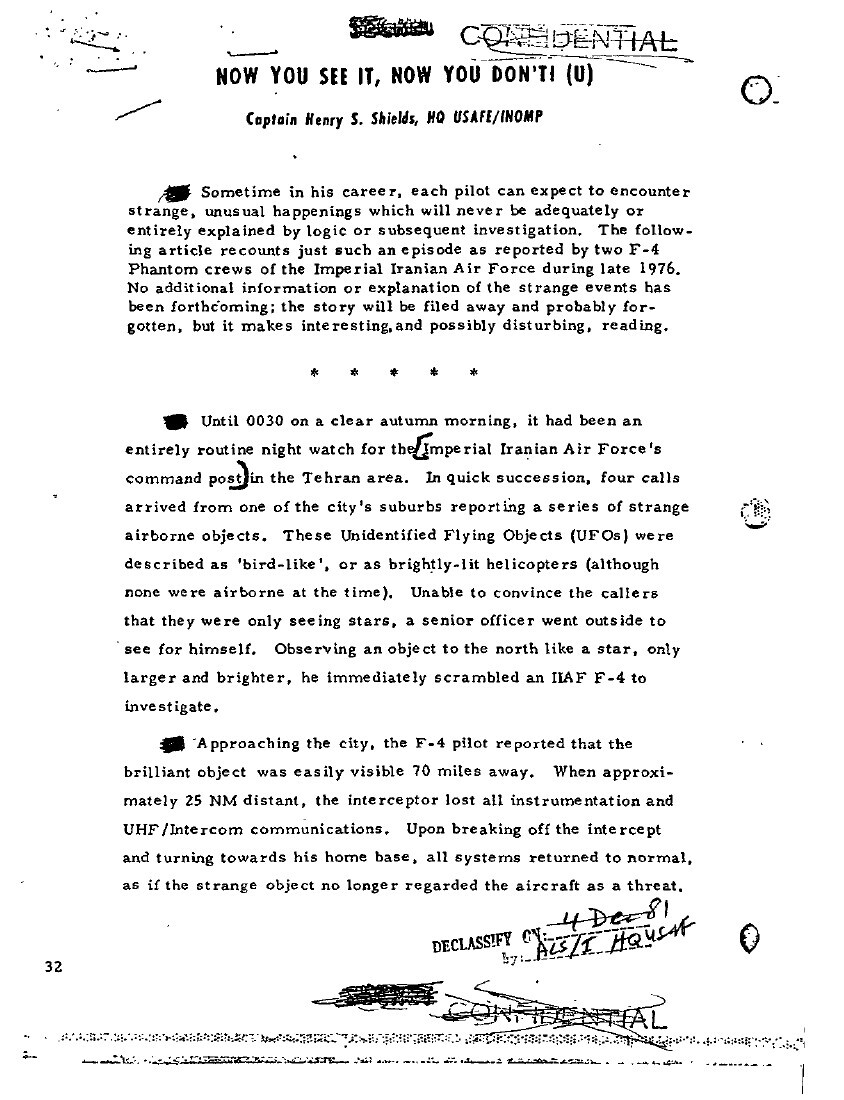
The first page of Capt. Henry S. Shields’s article on the Tehran incident in the US Air Force’s MIJI Quarterly, October 1978, still bearing its “Confidential” markings and a 1981 declassification stamp. (US Air Force, public domain, via Wikimedia Commons)
Sources: Joint Chiefs of Staff Message Center copy of USDAO Tehran message, Sept. 23, 1976 · DIA Defense Information Report Evaluation (1976) · DIA routing and transmittal slip, Dec. 8, 1978 (all reproduced by NICAP) · International UFO Reporter article in the NSA’s declassified UFO files · Capt. Henry S. Shields, “Now You See It, Now You Don’t!”, USAF MIJI Quarterly (Oct. 1978), via Wikimedia Commons
How the Public Found Out
None of this was announced. It came out because private citizens asked for it.
The message was never released voluntarily. A researcher named Charles Huffer, after being turned down while in Germany, obtained a copy under the Freedom of Information Act on a trip to the United States, and the International UFO Reporter published it. A copy of that article sits in the National Security Agency’s own declassified UFO files. In 1997, answering a FOIA request from John Greenewald Jr. of The Black Vault, the Office of the Assistant Secretary of Defense released a packet of UFO records that again included the message.
Jafari, who later retired as a general, described the encounter publicly at a press conference at the National Press Club in Washington in 2007, alongside military and aviation witnesses from several countries.
Sources: International UFO Reporter, “The U.S. Government & ‘The Iran’ Case,” in the NSA’s declassified UFO files · Office of the Assistant Secretary of Defense, FOIA response 97-F-1677 to John Greenewald Jr. (Sept. 1997), The Black Vault · Kean (2010)
Skepticism and Alternative Explanations
The case has well-known critics. Here are their arguments, and what they leave open.
A planet. The journalist Philip Klass argued that the bright light first seen from Tehran was probably the planet Jupiter, and the space analyst James Oberg has cited the same explanation. Jupiter was in fact up that night, high in the eastern sky and brighter than any star. A star-like light seen from the ground fits it well.
Equipment failure. Klass reported that, according to a technician at the base, only the first jet had equipment trouble, and that this aircraft had a history of electrical faults and had been repaired shortly before. He also suggested the radar may have been in a mode that could give a misleading lock, and that tired, rattled crews could have mistaken stars or meteors for craft. Fighter jets do have electrical faults, and airliners carry backup radios for a reason.
Meteors and tired crews. The skeptic Brian Dunning has pointed out that the night fell during annual meteor showers, so falling lights would not be unusual. He also reported that, according to a US Air Force officer who attended the Iranian debriefing, the beeper heard the next day appeared to come from an American C-141 transport plane.
A secondhand report. The message itself notes that its information came from a conversation with one of the F-4 pilots. It is not a transcript of radar data or a formal investigation.
What is still open. A planet does not show up on radar the size of a tanker, move away to hold its distance, or, as the crew described, release smaller lights that maneuver and rejoin it. The skeptic case asks for several things to go wrong at once: a planet mistaken for a craft, a radar misreading, an electrical fault in a second aircraft at the moment its pilot tried to fire, a radio failure in a passing airliner, and meteors that happened to look like objects leaving the main one. Each of those is possible. All of them together, on the same night, in the same part of the sky, is what the DIA analyst was weighing when he wrote that the case met the criteria for serious study.
Sources: Philip J. Klass, UFOs: The Public Deceived (1983), as summarized in Martin Bridgstock, Beyond Belief (2009) · Brian Dunning, “The Tehran 1976 UFO,” Skeptoid #315 (2012) · USDAO Tehran message, Sept. 23, 1976, “RD comments.”
Why Tehran Matters
The Tehran case is a reminder that some of the best UFO evidence is not in private hands. It is in government files, written by officers who had no reason to embellish and every reason to be careful. Here a general, two fighter crews and airport controllers were among the witnesses, an intelligence analyst said the case met the standard for serious study, and the report went to the White House. Then the record goes quiet.
The message promised more information. Nearly fifty years later, the public has never seen it. That gap is exactly what the UAP Disclosure Act is meant to close, by gathering records like these into one public collection and reviewing what is still withheld. NPI supports it, and you can help.
Further Reading
- US Defense Attaché Office, Tehran, message to DIA, Sept. 23, 1976, with DIA evaluation and routing slip (NICAP)
- International UFO Reporter, “The U.S. Government & ‘The Iran’ Case” (NSA declassified UFO files)
- Office of the Assistant Secretary of Defense, FOIA release 97-F-1677 (The Black Vault, 1997)
- Leslie Kean, UFOs: Generals, Pilots, and Government Officials Go on the Record (2010)
- Brian Dunning, “The Tehran 1976 UFO,” Skeptoid #315 (2012)
Citizens for Disclosure
Records like the Tehran message reached the public because citizens asked for them. Citizens for Disclosure is NPI’s national volunteer network, working to make sure the rest of the record comes out too. It is free to join, no donation is required, and our team will help you find your place in it.
Related
- Case Study: The Malmstrom Missile Shutdowns, 1967 · Core Learning Tool
- Case Study: The Rendlesham Forest Incident, 1980 · Core Learning Tool
- Case Study: Jimmy Carter’s 1969 UFO Sighting · Core Learning Tool
- Case Study: Betty and Barney Hill, 1961 · Core Learning Tool

